
The South African market is in a “Perfect Break” situation at the moment, according to market analysts Craig Aitchison and Trevor Abromowitz.
 During the last 10 years, we have often heard the phrase, “the Perfect Storm” applied to periods when both equity markets and interest rates fall. This is extremely problematic for investors for the following reasons:
1. The investor has less capital because of the fall in equity markets (assuming that the investor is invested in equities or a balanced portfolio)
2. The investor’s ability to fund liabilities decreases because of the fall in interest rates (assuming that the investor has future obligations or cash flows linked to interest rates)
While many investors have faced this challenge over the past years, indications are that the situation is changing completely, and investment opportunities are opening up for those who are aware of how the market is behaving.
From the Perfect Storm to the Perfect Break
In snooker, the perfect break occurs when a single player consecutively pots all the balls on the table in a particular sequence to score the highest possible snooker score. It is a rare feat and in professional tournaments there is usually a substantial prize for any player achieving such a break.
In the financial sense, the “Perfect Break” is the exact opposite of the Perfect Storm and refers to a period when both equity markets and interest rates rise.
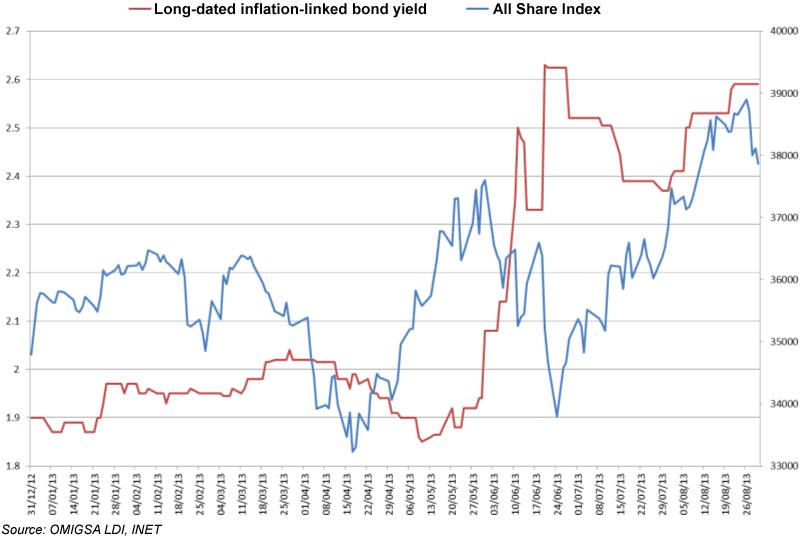
Consider the graph below. Between the beginning of May 2013 and the end of August 2013, the All Share Index (ALSI) increased from a level of 34 364 to a level of 37 864 (refer to the right-hand vertical axis) – an increase of more than 10%. Over the same period, long-dated inflation linked bond rates have increased from 1.9% to over 2.59% (refer to the left-hand vertical axis) – an increase of 0.69%. This implies a reduction of over 10% in the cost of purchasing protection on an investor’s inflation-linked cash flows (assuming the cash flows have a duration of 15 years).
Click to enlarge
So what does this mean for investors?
Investors who recognise the signs and realise that the market is in a Perfect Break need to decide if the opportunity justifies the risk. Their decision will depend on a number of factors, including:
1. The investor’s objectives: If, for example, the investor’s objective is to pay pensions equal to 100% of inflation, then de-risking may be an appropriate solution.
2. The risk appetite of the investor: If the investor’s objective is to pay pensions equal to 100% of inflation and has a high risk appetite, then the investor could retain its mismatched position in search of higher than inflationary increases or a further improvement in its funding position.
3. The investor’s time horizon: if the investor has a short time horizon, the investor could use this as an opportunity to lock in the surplus generated over the period.
As with snooker, the Perfect Break is rare. Investors therefore need to be realistic and appreciate that the market can move out of a Perfect Break suddenly and unexpectedly. However, by closely monitoring their assets and liabilities, both institutional and retail investors can take advantage of the Perfect Break and achieve the prize of meeting their investment objectives.
Craig Aitchison is GM Corporate Customer Solutions at Old Mutual Corporate, and Trevor Abromowitz is Head: Institutional Business (Liability Driven Investments) at Omigsa






0 Comments