
 In 2009, value-based asset manager RECM was very vocal about the fact that mining companies – the market darlings of the time – were both overvalued and over-owned. In addition, it was of the opinion that these companies were poorly managed and their business models did not generate very much cash.
As a result, the asset manager’s client portfolios held very few of these stocks. However, according to Piet Viljoen, Chairman of RECM, today RECM’s funds are very heavily exposed to certain mining companies. So what has changed?
In short, says Viljoen, just about everything. He refers to the following points:
- The CEOs of all three major mining companies have changed since 2009: at Anglo American, Mark Cutifani has replaced Cynthia Carrol, while Tom Albanese was replaced as Rio Tinto CEO by Sam Walsh. In May 2013, Marius Kloppers, the CEO of BHP was replaced by Andrew Mackenzie.
- In all three cases, the CEOs resigned after presiding over significant capital destruction. Carrol was forced to write down Anglo’s iron ore assets by $4 billion, Albanese presided over the $14 billion write-down of Rio’s aluminium assets, while Kloppers was at the helm when BHP wrote down at least $7 billion of shale gas, aluminium and nickel assets.
- The new leadership in resource companies are all singing from the same hymn sheet: less capital expenditure, more cash flow. This is good news for shareholders, after suffering from the hubris of previous leaders. After all, it is cash flow that ultimately determines value, not attention-grabbing deals.
- Of course, less capital expenditure today in many instances also means production cutbacks in future. This could lead to increasing commodity prices down the line, as demand normalises into a period when production is stagnant or even declining. The lead time to increase mining production is counted in years, not months. Environmental reviews need to be done, mining infrastructure must be built out and fairly deep holes have to be dug in order to produce anything. Once you cut back production, it takes a while to restart it. This is the fundamental essence of the commodity cycle.
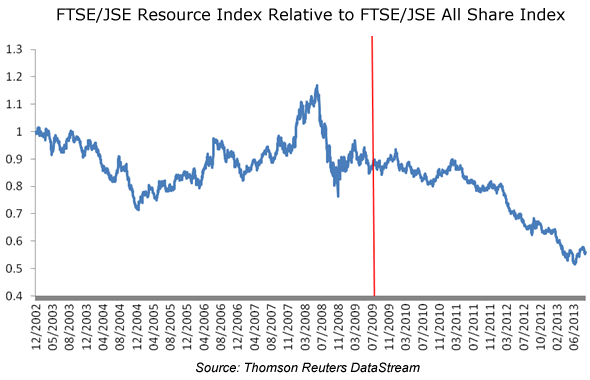
- Resource companies have underperformed the broad market substantially since 2009. This poor relative performance has caused many investors to sell their resource shares. Sentiment towards these companies has also soured somewhat. In 15 years, we’ve come full cycle: in 1998 BHP was regarded as the worst company in Australia by most market pundits. At the peak of the commodity ‘supercycle’, it had ascended the throne as the best company in Australia. Today, the disdain towards the company is widespread again.
The chart below shows how resource companies have fared against the All Share Index over the past decade.
Click to enlarge
Viljoen says that it shows clearly how the so-called commodity super cycle was no more than a normal cycle. Resource shares have, since 2008, continued their long-term downtrend relative to the market – a downtrend which has been in place for decades.
“A valid question might well be, in the light of the long-term underperformance of these companies, why do we own them today?” asks Viljoen
“Although we think that the intrinsic value of these businesses has deteriorated somewhat over the past four years, prices have dropped much more than value. Today, we think prices for many resource stocks are trading below intrinsic value, presenting a satisfactory margin of safety.
“So today, these companies possess the qualities which value investors look for – new management doing sensible things and shares priced with a satisfactory margin of safety. These facts are no guarantee of investment success, but at least they put the odds in our favour. If things continue to go badly, despite new management’s best efforts, we won’t lose a lot of money on these investments. However, if there’s some improvement we could enjoy high returns, as the market reprices the shares accordingly. And that’s the sort of payoff profile we generally look for,” concludes Viljoen.






0 Comments