
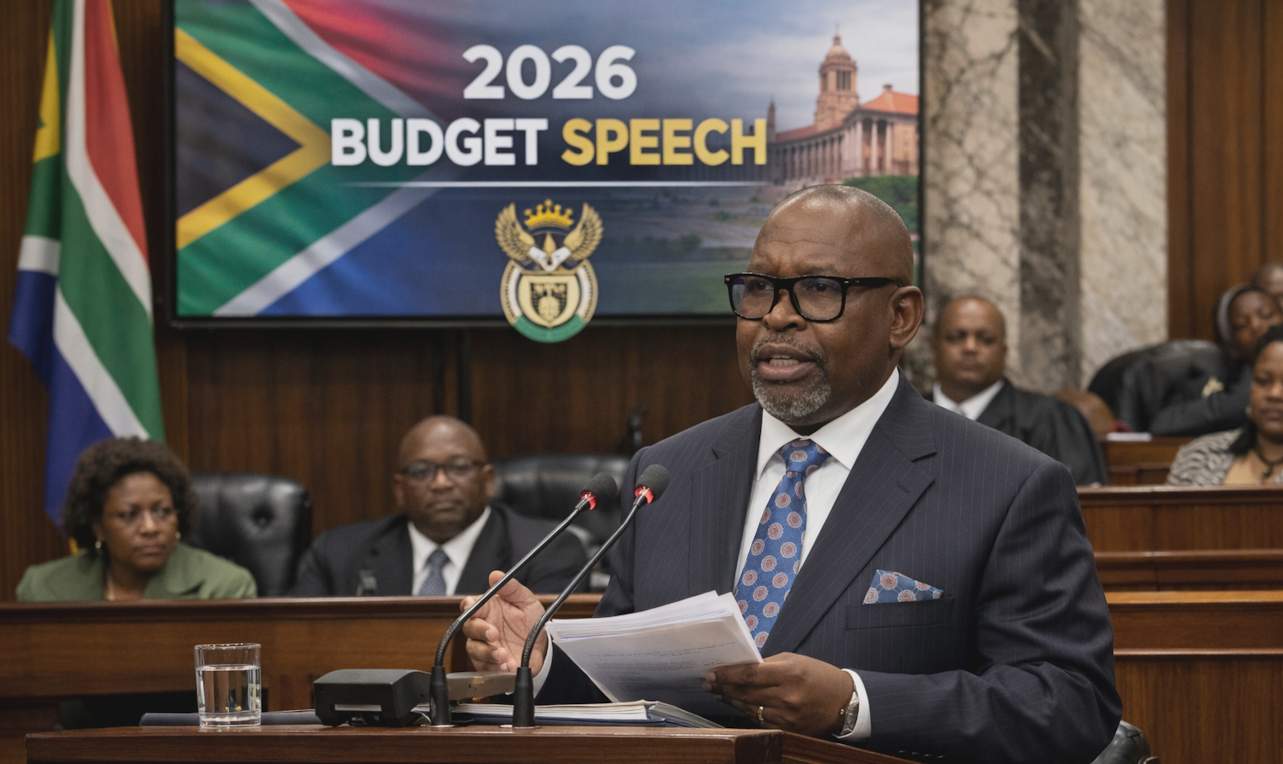
There was a lot of good news in the 2026 Budget Speech for investors and savers, but our personal income taxes remain higher than they should be.
Ahead of today’s Budget Speech, I was expecting changes to the tax limits and thresholds for our investments, but I was pleasantly surprised by the scope of the increases announced by Finance Minister Enoch Godongwana.
 For individuals, Treasury adjusted the limits on our TFSA annual contributions and our retirement fund contributions, and increased capital gains tax exemptions.
However, I was disappointed by the failure to adjust the lifetime limit on TFSAs, which remains at R500 000. The sentiment from Treasury is that anyone who can afford to invest R500 000 does not need further tax relief on their investments.
I was thrilled to see the significant increase in the VAT threshold from R1 million to R2.3 million, as well as the same increase in limits for micro-businesses that qualify for turnover tax.
Previously, a micro-business could qualify for turnover tax only if its turnover was less than R1 million. This limit has been increased to R2.3 million. This limit was last adjusted in 2009, failing to keep pace with inflation, resulting in fewer businesses qualifying for the turnover tax regime. This has all been good news for micro-businesses.
Yet we should not forget that Treasury effectively increased our tax rate by not adjusting for inflation in 2024 and 2025. This means we are still paying R34 billion more in tax than we should be.
We can never recover from that compounding effect – and the increases to our tax limits and thresholds on investments are a small compensation.
In 2007, personal income tax accounted for around 28% of total revenue, compared with nearly 40% today – a heavy burden for a small tax base.
The top 13% of individual taxpayers pay over 60% of personal income tax, and nearly half of personal income tax is paid by the 7.7% of taxpayers with taxable income above R1 million per year.
Details of what’s changed for the 2026-27 tax year
Apart from the usual increases in sin taxes and fuel levies, all of which go up by inflation (3.4%), here are the other changes for the 2026-27 tax year:
- The annual limit for contributions to a tax-free savings account will increase to R46 000 (from the current R36 000).
- The cap on the amount an individual can contribute to a retirement fund will increase to R430 000 per annum (from the current R350 000).
- Any member retiring from a fund with a balance below R150 000 will not be required to purchase an annuity.
- Investors with an existing living annuity will be able to withdraw the full balance once the fund value drops to R150 000. However, this will apply cumulatively if the investor has more than one living annuity with the same insurer.
- Individuals will be able to donate up to R150 000 a year before triggering the 20% donations tax rate.
- The annual exclusion for capital gains tax (CGT) will increase from R40 000 to R50 000.
- The CGT exclusion on the sale of a primary residence will increase from R2 million to R3 million.
- The CGT exclusion at death will increase from R300 000 to R440 000.
- South Africans will be able to take up to R2 million offshore without tax clearance or exchange control approval.
- Any small business owner over 55 who sells their business worth less than R15 million will not pay CGT on the first R2.7 million of capital gain.
- The threshold to register a business for VAT will increase to R2.3 million.




This is informative. I need more on tax free investment. I currently have a handful fixed deposit . They are not tax free. Can demand that their conversion to tax free accounts. They are less than R3K with different banks.
You can open a TFSA and transfer the funds into them. Just makes sure you do not exceed the R46 000 annual limit. But you may want to read this to understand why a fixed deposit is not necessarily the ideal investment for a TFSA https://mayaonmoney.co.za/what-is-a-tfsa-and-why-you-should-open-one/