
The great thing about getting your first paycheque is that you have the opportunity to do the right things before the bad habits kick in.
 The day that first paycheque hits your bank account you feel like you have finally arrived. But how you manage that money will determine your future wealth.
Right now is the best opportunity to build your finances before you have commitments like children and a mortgage.
Having the latest iPhone or BMW may impress your friends now, but having serious money in your bank account at the age of 30 will impress them for longer.
Protect your income
When you are young, your future earning potential is your biggest asset. What happens if you can’t work? Accident rates are the highest among young people.
Speak to your employer and find out if you are covered if you are disabled and unable to work. If not, take out your own insurance cover.
Most insurance companies offer future life cover which means you can take out disability and income protection today but can extend that to life cover as you get older. If you get married and start a family and you want to add life cover to your existing policy, you won’t have to undergo any medical tests.
Some insurance companies have very flexible insurance products that you can ramp up or cut back depending on your changing needs.
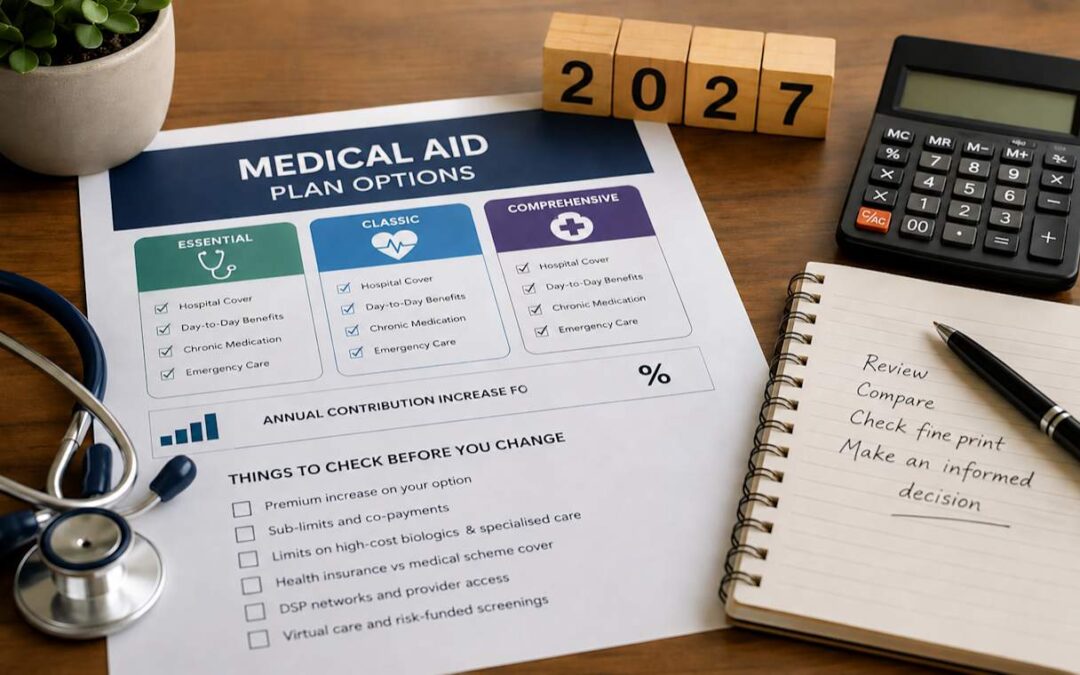
Medical cover
You are young and healthy so you don’t necessarily need a comprehensive medical plan, but you want to know the bills will be taken care of in the case of an emergency.
If your company doesn’t offer medical cover, invest in a hospital plan so your parents don’t have to take out a second mortgage if you land up in hospital. Most medical schemes offer an entry-level hospital plan.
If you feel you need something a bit more comprehensive, to cover out-of-hospital expenses as well, most medical schemes offer cover based on your income level.
Retirement
It may seem like a very, very long way away, but your older self will thank you for starting early.
The earlier you start saving the more options you will have when you are older. Do you want to be stuck to your desk until the age of 65 or do you want the freedom to follow your dreams at the age of 50?
Make sure you are signed up for the maximum retirement contribution at work. Aim for your total contribution (employer and employee) to be at least 15%. If you save 15% of your salary from your first job you will never have to worry about retirement.
If your company does not offer a retirement plan, you can take out your own retirement annuity (RA) if you earn more than R10 000 a month. If you earn less than that, you will not benefit significantly from the tax deduction of an RA so rather max out your tax-free savings account, and think about an RA once your salary starts to grow.
Emergency savings
Life happens – and you can be certain that at some point, you will be faced with a large and unexpected expense. You don’t want to end up in debt and facing judgments because of it.
Aim to have three months of your take-home pay saved in an emergency fund, with at least one month’s worth of expenses immediately accessible. Aim to reach this amount over the next three years, starting with R10 000 as your first goal.
Shop around to see which bank account has the highest interest rate for small amounts, and once you have saved enough to qualify, you can look into a money market unit trust account, which usually have slightly better interest rates than a bank account.
Regular savings
Money gives you choices. The more money you save, the more choices you have. And we are not talking about the choice between the latest iPhone and Samsung; we are talking real choices like owning your own home, being your own boss, or going to the next World Cup.
If you opt for a car that costs R250 000 instead of R350 000, and you invest the difference in repayments each month, after five years you will have saved R135 000 – enough to put down a deposit on a townhouse.
For an investment with a time horizon of more than five years, exchange-traded funds (offered by companies like Satrix, Sygnia and CoreShares) offer low-cost, frills-free investment options. Also consider unit trusts with fund managers like Coronation, Allan Gray and NinetyOne.
For shorter-term savings consider a fixed deposit or money market unit trust fund.
Increase savings without cutting your lifestyle
Set a five-year goal that increases your savings each year using a small percentage of your salary increase until you are saving 10% of your salary. This is the concept behind the “Save More Tomorrow” plan described in the book Nudge.
Authors Richard Thaler and Cass Sustein introduced this scheme in Australia and after 4 years, 78% of people remained committed to the plan. The average investor had increased their level of savings from 3.5% to 13.6% within those four years.
For example if this year you received a 7% salary increase, sign a debit order immediately to put 2% of your additional income into a savings account. Every year commit to increasing that debit order by a further 2% of your salary. Within five years you will be saving 10% of your salary without having to cut back on your spending.
Another way to achieve this would be to commit to saving an amount that increases by a few percent ahead of inflation each year, for example a 9%-10% escalation on your monthly savings plan.
This article first appeared in City Press.





0 Comments