
Adrian Saville, CIO of Cannon Asset Managers, explains the fallacy of relying on a weak currency
There is prevailing conventional wisdom among labour and certain parts of government and industry that a weak rand will reverse South Africa’s sagging industrial competitiveness, thereby lifting economic growth and redressing our unemployment problem.
But since 2011 the rand has steadily weakened and where are the jobs? Why hasn’t a weaker rand saved us?
Part of the answer can be found in Chart 1, which shows changes to South African manufacturing output relative to changes in the real effective exchange rate of the rand, with output lagged by one year to allow industry sufficient time to respond.
When we analyse the scatter chart, we see that there doesn’t seem to be any discernible relationship between currency and manufacturing output from 1980 to present. Indeed, the correlation is a mere 4.6%, meaning that currency movement explains under 5% of the change in South African manufacturing between 1980 and 2013.
Chart 1 also suggests, counter intuitively, that South African manufacturers perform better – not worse – under conditions of a strengthening rand.

Click to enlarge

Click to enlarge
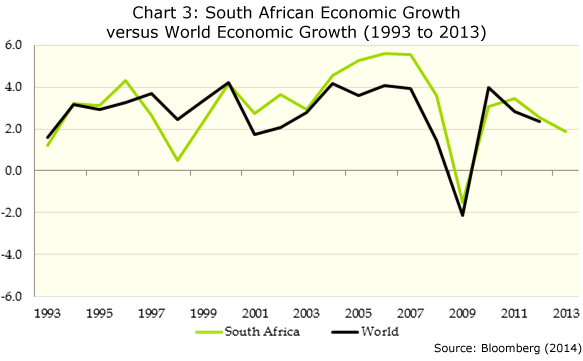
Put simply, something other than the rand drives our industrial activity, and we think the explanation can be found outside the country, namely in global economic growth. When the global economy prospers, our economy prospers, almost irrespective of the level of the rand. Indeed, Chart 3 indicates that at least three-quarters of SA’s economic growth can be explained by global growth.
Click to enlarge
If a weak rand doesn’t seem to help our manufacturing sector, and we are reliant on world economic growth (which we can’t control) to drive our economy, what can we control to create jobs, employment and prosperity, and where has South Africa been going wrong?
To us, the answer lies in Chart 4, which shows that real wages have grown 32.6% since 2000, while labour productivity has fallen 13.9%. Rising real wages are a great achievement for any country. But if wage increases are not matched (or exceeded) by gains in productivity, competitiveness is in reverse. Essentially, South Africa’s labour force is 45% less competitive than it was 12 years ago, against a backdrop of increasing global labour competitiveness. A weaker currency does not solve this problem. Rather, it pushes up imported inflation and this aggravates the cost of labour as wages rise to compensate for inflation which, in turn, makes employers less willing to hire new workers.

Click to enlarge
Low productivity, poor eduction
With only 5% of South Africa’s manufacturing capacity being explained by currency, we believe that the other 95% resides in three elements which have the greatest prospect for shaping South Africa’s economic landscape: we have too few firms, our productivity is too low and we have poor education levels.
Every time the rand weakens, South Africa’s balance sheet and income statement are weakened. So if becoming poor is a way to become rich then we should allow the rand to keep weakening. But if South Africa is serious about improving employment, we need to be more competitive, which will in turn make employers more willing to invest and hire more staff.
In the long term, only a substantial improvement in the quality of education, coupled with other important drivers of productivity that include managerial capacity and infrastructural productivity, can drive these required gains. In the nearer term, productivity-linked real pay increases may be at least one way in which these principles in the business, labour and policy environment become entrenched.
Rather than a weaker rand, South Africa needs a new social pact with a serious commitment between labour, government and business to achieve the above. South Africa can solve its unemployment problems with strong political will and even stronger leadership on all sides.
This article was supplied by Cannon Asset Managers, a niche investment management company that applies the philosophy and principles of value investing.






0 Comments