
Andrew Newell, Head of Business Development at Cannon Asset Managers, looks at reasons why the rand may surprise on the upside.
 After the recent sharp fall of the rand against the dollar and other developed-market currencies, our clients are asking us if the rand is a “one-way bet”, in that it can only devalue over time. The implied question is whether they should invest as much as possible overseas. Our stand on this issue is that the decision to invest overseas should not be based on a view of the currency’s direction, as the choice of asset is far more important in determining returns than any rand movements.
But that still doesn’t answer the currency question. In short, while we think it is nearly impossible to forecast the rand’s movements with any accuracy, take a look at the following graph.
Chart 1 shows how the amount of physical money (notes, coins and “electronic money”) in 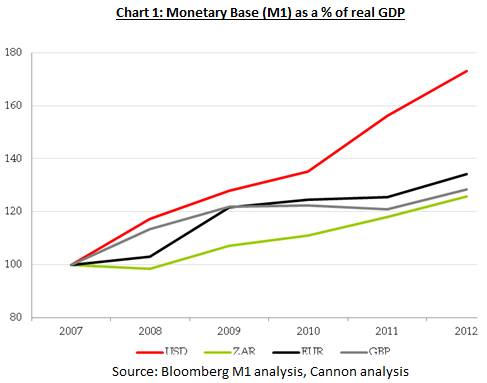 circulation for each currency has increased relative to the size of that country’s economy (adjusted for inflation). We highlight the rand versus the three currencies that South African investors are most likely to own abroad – dollars, pounds and euros – and to most people’s surprise, South Africa has “printed” the least amount of money over the last few years versus these so-called “hard” currencies. Basically, more dollars, pounds and euros have been put into circulation than rands over this period.
So what are the implications of this? Simple economics tells us that if you increase the supply of any item relative to that of another item, over time you are likely to decrease the value of the first item relative to that of the relatively scarce second item. And while we know currency issues are very complex, at the most basic level, South Africa has printed less money (relative money supply) than these economies, which suggests their currencies (especially the dollar) are likely to devalue relative to the rand over the medium to longer term.
And so while it is easy to get swept up with our nearer term negative news flow at present, such as our trade deficit (we are importing too much, and exporting too little), the commodity cycle, labour issues, mining, electricity, government policy and so on, all of these primarily impact on the “demand” for rands, and we therefore caution investors not to lose sight of the long-term “supply” side of the equation. The rand could surprise on the upside, which further supports our case for investing overseas for diversification purposes and asset selection, rather than basing an investment decision on views on the currency.
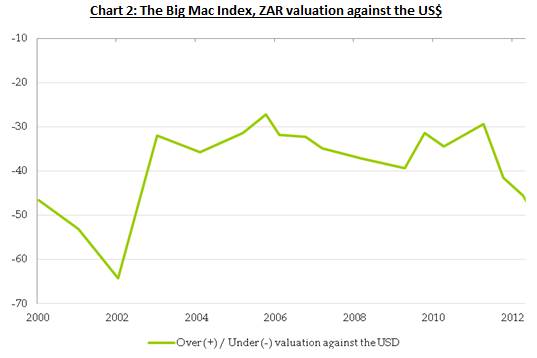
On a lighter note, take a look at The Economist’s Big Mac Index. This index is widely used as a not-so-serious guide to determine whether exchange rates are at their “correct” level. It assumes that, as Big Mac burgers contain the same ingredients and use the same power, space, equipment and labour (effort) to make around the world, they should cost the same around the world in dollars. But they don’t. The chart below shows the cost of a Big Mac in South Africa in dollars, versus buying one in the USA in dollars. The burger is currently 50% cheaper in SA relative to the US. “Burgernomics” says that the rand is undervalued at the moment and should strengthen. Doesn’t that just make you want to rush out and buy a South African Big Mac?






0 Comments