
By Sanisha Packirisamy (Economist) and Herman van Papendorp (Head of macro research) at MMI Holdings.
 Global central banks to remain in the spotlight
 Global central banks to remain in the spotlight
We are likely to see a further desynchronisation in major global economies in 2016 as a firmer growth outlook and stable inflation expectations prompt central banks to nudge monetary policy rates higher from ultra-low levels in the United States (US) and United Kingdom, while significantly negative output gaps, weak growth trajectories and benign inflation prints continue to put pressure on the European Central bank (ECB) and Bank of Japan (BoJ) to find new ways of stimulating growth and boosting inflation.
In an effort to spur price pressures and drive export growth higher, the ECB recently pledged an extension of their €60 billion (per month) bond purchasing programme to March 2017 and cut their key deposit rate to a historic low of -0.3%. Yet, even with this level of unprecedented easing, stimulus efforts only amount to roughly 15% of Eurozone GDP (see chart 1), much lower than the 25% of GDP assets previously purchased by the likes of the US Federal Reserve (Fed) or the Bank of England (BoE). As a result, an even stronger easing package may have to be announced next year in the event of further disappointments in growth and inflation prints.

Though weakness in exports and sluggish fixed investment growth threatens to weigh negatively on the recovery underway in the US, the country remains the (relative) bright spot within a weak global environment. Solid domestic demand, positive services momentum and continued progress in the labour and housing markets suggest that the US economy is on firm-enough footing to gradually step away from ultra-accommodative monetary policy.
Nevertheless, tighter monetary conditions from a stronger greenback, benign wage inflation and the threat of negative spillover effects from a bumpy global economic recovery suggest that Fed officials will not be in a rush to hike rates aggressively, which could keep the target federal funds rate below “normal” levels for quite some time.
Structural problems afflicting emerging market economies in 2016
Although the pace in the growth slowdown in emerging markets has decelerated since the start of 2015, we expect challenging growth conditions to persist against a backdrop of sluggish global trade activity (due to lower demand, onshoring and a China slowdown driving commodity prices weaker) and slowing growth in domestic demand, in the absence of further significant support from monetary and fiscal policy.
In addition, rising interest rate prospects for the US poses tighter monetary conditions for emerging economies, particularly those running extended current account deficits. While potential currency weakness may partly negate the effect of declining portfolio flows through rising domestic interest rates, a weak growth backdrop may limit the extent of EM rate hikes while higher inflation could push real rates lower.
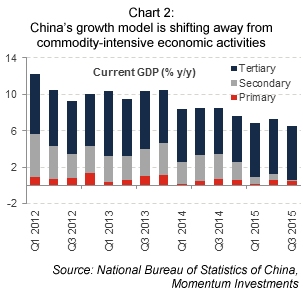
China’s phenomenal growth performance in recent decades has been impressive, but is set to slow over upcoming years. The latest (official) GDP data indicates that growth in the world’s second-largest economy is losing momentum from the average 9.8% rate of increase observed since 1980, to 6.9% more recently in 3Q15. Growth in China is likely to slow further over the next five years as Chinese officials implement their plan to reorient GDP to a more sustainable and balanced model.
In an environment where China re-aligns its growth profile away from infrastructure and export-led GDP towards driving the consumption and services share of the economy higher (see chart 2), we are unlikely to see commodity prices staging a sharp recovery. An overhang in the global supply of key commodities further points to little support for a significant reacceleration in commodity prices in the coming years.
Though there is potential for India to take up China’s mantle as possibly the next dominant player in world commodity demand in the future, growth in India’s commodity consumption over the next ten years is unlikely to replicate the demand shock created by China over the past decade and a half. The World Bank’s latest quarterly commodity outlook report stressed the different growth models and consumption patterns in the two countries. Although China’s consumption of metals and coal has surged to 50% of global demand, India’s consumption of metals and coal sits at a more modest 3% and 9%, respectively. India’s democratic rule of law may also hinder a faster acceleration in the rollout of commodity-intensive infrastructure projects.
In this context, net commodity-exporting countries, particularly those facing large external current account deficits, are likely to face a less favourable terms-of-trade trajectory over the next while, suppressing economic prospects in the absence of growth-enhancing structural reforms.
Unexciting growth prospects lie ahead for SA
In light of softer global trade growth, downbeat domestic demand, continued policy uncertainty and infrastructure bottlenecks, South Africa is likely facing trend growth of closer to 2% over the next five years ‒ a far cry from the longer-term historical rate of above 3%.
Lacklustre fixed investment intentions, rising fiscal pressures, a dismal employment outlook and a dip in real wages are likely to inhibit a faster acceleration in domestic demand growth in 2016, while the benefit of a weaker rand is likely to be curbed somewhat by softer domestic demand conditions in SA’s key emerging-market trade partners. Consequently, real growth in SA is likely to underperform our estimate of potential growth next year, with the economy expanding at a rate only marginally higher than the c.1.5% growth rate expected for 2015 as a whole.
Meanwhile, the South African Reserve Bank (SARB) has warned that the recent convergence in medium-term inflation expectations (by analysts, firms and trade unions) at close to the upper end of the 3- 6% inflation target band threatens higher price setting in the SA economy. Moreover, with inflation expected to temporarily breach the top end in early 2016, and averaging just below 6% for the year as a whole, any significant unforeseen currency depreciation poses the risk of an extended inflation breach despite the weaker currency pass-through observed to date. A still-extended current account deficit further argues for another 25 basis point hike in the repo rate in early 2016 in order to keep real policy rates in positive territory as we deal with the Federal Reserve’s take off in interest rates from historically-low levels.
A lower growth outlook highlights the likelihood of negative fiscal revenue surprises as South African corporates face a benign commodity outlook and rising input pressures. In the absence of any new revenue proposals, lacklustre jobs growth and lower growth in real wages in 2016 could see personal income tax and VAT collections undershooting Treasury’s relatively optimistic revenue targets.
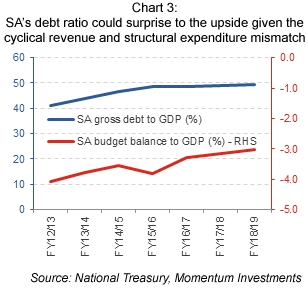
An escalating wage bill continues to threaten government’s expenditure ceiling. A higher allocation to the public servant wage bill and rising debt-servicing costs are contributing to the gradual crowding-out of capital investment, limiting SA’s growth potential to a greater extent. A further delay in fiscal consolidation could see a worsening in government debt ratios (see chart 3), raising concerns over SA’s ability to maintain its investment-grade rating beyond the short term.
Averting a sovereign debt downgrade to junk status is still an attainable goal. If government commits to reducing the bloated public sector wage bill by constraining employment additions, curbing wasteful expenditure through cracking down on corruption and dedicating resources to reduce maladministration in South Africa’s state-owned corporations, the trajectory of structural expenditure will improve. Acting on a number of proposed economic reforms, in the labour and product markets, in particular, will cultivate higher rates of economic growth, allowing SA to grow its way out of a potential debt crisis, even in the absence of another commodity super-cycle.
However, if the South African government does not react to growing fiscal risks in time, further expected cuts to longer-term capital expenditure in favour of current spend will exacerbate benign domestic growth projections, eventually forcing government debt ratios even higher. Rising interest expenditure, from the current 3.1% of GDP, would further crowd out other forms of more beneficial growth-enhancing spend. A larger debt burden, reduced sovereign creditworthiness and lower inward investment would perpetuate a poor growth environment, fuelling a weak growth-high debt cycle.






0 Comments